Sunday, October 31, 2010

The Gallup Organization: Creating a Successful Sales Culture

Your front-line managers can drive sales -- or drive away your best salespeople

by Benson Smith and Tony Rutigliano
Authors of Discover Your Sales Strengths (Warner Books, 2003)

A sales force is built on the capabilities of its managers. Front-line supervisors play a key role in influencing the performance of the salespeople they manage and motivate. In fact, these managers are more important in driving sales results than anyone else in the company.

But what about the CEO, or the vice president of sales? Don't they drive sales performance? Not necessarily, according to The Gallup Organization's research. Our studies suggest that 80% of a sales representative's perception of company leaders was influenced by that salesperson's relationship with his or her direct supervisor. No matter how good the CEO was, or the vice president of sales was, the sales reps' view of these individuals was strongly colored by their opinion of their direct supervisor.

We saw this very situation play out at a recent sales meeting at a client organization. We were impressed by the talk the new CEO gave to the company sales force. In his address, the CEO candidly spelled out the problems facing the company, but also unequivocally committed the resources necessary to fix those problems. He described the kind of company they were working to build and what the future could and should be for the employees, the company, and their customers. It was an inspiring talk.

Afterwards, we went up to one of the sales representatives and asked his opinion of the speech. "It was wonderful," he told us. "I would really like to work for that company." We were surprised by his answer, since his nametag clearly indicated he was an employee of the company. "Don't you already?" we asked, puzzled by his response. "No," he told us, pointing to an individual across the room, "I work for that S.O.B. over there!"

This brief exchange helped us understand what Gallup's data so dramatically demonstrates: We may join a company, but we work for a manager. Gallup has found that when top producers leave companies, 70% of the time it is because of a breakdown in their relationship with their direct supervisor. And conversely, when we find sales stars, we almost always find a great manager in the shadows.
A CEO's speech, no matter how motivating, does not create a company culture. Contests, glamour trips, and commission plans do not create cultures. Front-line managers create cultures within their individual sales teams. This realization became crystal clear as we began to study cultures within organizations.

What is culture, exactly?

Let's define "culture." At Gallup, our researchers define it as the attitudes that employees have about the environment in which they work. We calibrate or measure the strength of that culture based on employee responses to 12 question items; these items, in turn, link to significant business outcomes, such as productivity, retention, profitability, and customer loyalty.

When employees -- in this case, sales representatives -- feel positive about their work environment as measured by their responses to those 12 key issues, we describe those employees as "engaged." As a group, engaged sales representatives sell significantly more than their less engaged counterparts. They are more likely to stay with the company and they are better at generating customer loyalty.

Sales representatives who are not engaged generate transactions, but they may not generate much customer loyalty in the process. As a group, they are considerably less productive than engaged sales reps. Actively disengaged sales representatives -- reps who are fundamentally disconnected from their work -- are not only at the low end of the productivity index, they actually erode customer loyalty.

We can measure the strength of the cultures in different sales teams by comparing the percentages of engaged, not engaged, and actively disengaged employees within that workgroup. We can also compare these results against our extensive database of responses collected from hundreds of thousands of workgroups across a broad spectrum of industries.

When we compared the cultures of individual sales units within organizations, we found wide variances. The chart below illustrates this point. The bar at the far left represents the overall engagement levels for the entire sales force. The remaining bars represent seven sales districts; each district includes 10 to 12 representatives that report to a district sales manager.

BAR GRAPH
Measuring engagement levels:

This chart compares the overall engagement levels for one
organization with the engagement levels for seven of its
sales units.


This sales force, as a whole, is one that can substantially improve. Only 19% of the sales force members are engaged in their work, and 30% are actively disengaged. These engagement levels are somewhat below average (26% engaged and 19% actively disengaged), and they are well below what we would see in a world-class sales organization (about 42% engaged and less than 10% actively disengaged).

But note the wide variance in engagement levels between the sales units. Clearly, the culture in Sales Unit E is completely different from the culture in Sales Unit C, but both workgroups are part of the same company. Each sales unit faces approximately the same competitors, the same market conditions, and the same opportunities.

What is driving the difference in workgroup culture within those sales units? After reviewing hundreds of similar charts, Gallup came to this conclusion: The difference is the manager. The manager sets the culture for his or her sales team, and the strength or weakness of that culture directly links to engagement levels -- and to business outcomes.

Good intentions, bad results

No manager gets up every day and goes to work determined to create the worst possible culture for his employees. But some managers unfailingly achieve this result -- for two reasons. First, some companies just put the wrong people in management roles. In too many organizations, star salespeople can only improve their income, status, or value to the company by moving into management. This frequently encourages the wrong people to seek supervisory roles.

Second, individuals with the talent to be good sales managers can create bad results if they lack management training and awareness. This year alone, we talked to nearly 1,000 sales managers who began their career in sales. We asked them to describe the amount of training they received as new sales representatives. In general, their training lasted a few weeks to several months and was relatively thorough. Yet when we asked the same group of managers to describe the training they received when they moved into their first sales management role, the typical answer was "none."

As a result, many sales managers have little understanding of what they must do to ensure a positive environment for their sales reps -- a culture that contributes to the improved performance of their most productive employees.

Remedies

How can companies find the right people to be sales managers -- the individuals who have good intentions and can produce outstanding results? First, companies can stop moving the wrong people into sales management roles. Companies need to pay more attention to selecting the right candidate for every sales management position. Sometimes this involves building a talent pool, by recruiting people with the talent to become outstanding sales managers into the sales force. Companies can also provide ample rewards and recognition to their sales stars, which might temper their desire to seek a management role simply for its perceived prestige.

We have also seen considerable improvement in workgroup engagement scores when managers are trained to focus on the 12 key issues that link to employee engagement and to business outcomes. Routinely measuring engagement scores also helps managers focus on these crucial areas.

Interestingly, but perhaps not surprisingly, managers who attain the highest initial engagement scores later show the biggest improvement in engagement scores. In the chart above, for example, we would typically see the biggest improvement in engagement scores from the managers of sales units B, E, and G. These managers already have the best engagement levels in the company. Any improvement in the level of engagement among their employees will tend to drive up the business outcomes for the whole organization.

In contrast, although the manager of Sales Unit G seems to have the most room for improvement, our experience shows that he is the manager who is least likely to show any substantial changes in his workgroup's engagement levels, even after training. He may well be a candidate for replacement.

The bottom line is clear: Front-line managers are instrumental in creating the right workgroup culture. Selecting and training front-line sales supervisors is one of the best and surest ways to improve the quality of your sales organization.


Having your FREE evaluation with a business coach is a $500 value.

Spin Selling: Always Try To Get An Advance


By Huthwaite (Creator of Spin Selling)

In major account sales, fewer than 10% of sales calls actually result in either an Order or a categorical No Sale. With neither an outright rejection or a contract in hand, how can you tell if a call is successful?

Our research shows that aside from a sale or a rejection, there are two other possible outcomes for a sales call: An advance and a continuation. Huthwaite defines an "advance" as an agreement from the buyer to take an action that moves the sale forward. Examples of advances include introducing the seller to another stakeholder in the account, agreeing to a product demonstration, or arranging for the technical teams from both organizations to meet. A “continuation” by contrast is where the sale will continue but there is no specific action agreed to by the customer to move it forward. The sale gets bogged down. Typical examples would be calls that end with a customer saying:

“Thank you for coming. Why don’t you visit us again the next time you’re in the area?”
“Fantastic presentation, we’re very impressed. Let’s meet again some time.”
“We liked what we saw and we’ll be in touch if we need to take things further.

On each sales call, aim for the biggest increment of commitment that you can realistically expect. Sales calls go nowhere unless the seller has a specific call objective.

Some common mistakes made in trying to obtain commitment include:

Failing to propose anything concrete
Proposing a Continuation
Proposing an unrealistic Advance
Not attempting to propose an Alternative Advance if needed
Holding back on proposing multiple Advances
The great thing with each sales call is to move the sale visibly and certainly forward with the customer’s tacit agreement that the sale is in fact moving forward by taking action.


Having your FREE evaluation with a business coach is a $500 value.

Spin Selling: Influencing Decision Criteria


By Huthwaite (Creator of Spin Selling)

Decision criteria are the criteria, standards, or dimensions which a person uses to make judgments or decisions. They are an essential part of decision-making. Without decision criteria a buyer has no mechanism for making choices between alternative solutions.

If you can help to define a customer’s decision criteria during the selling process, you are well on your way to winning more, and more profitable business. There are three basic rules for influencing decision criteria:

1. Develop decision criteria from needs you’ve uncovered during the Recognition of Needs phase of the sale.

2. Reinforce crucial decision criteria you can meet.

3. Build up incidental decision criteria in areas where you are strong.

Perhaps you recall what I mean when I say the Recognition of Needs phase—it is that period in the buying process during which a potential buyer begins to feel a certain pain in their current situation; problems with the status quo have begun to arise and they are becoming aware that something may need to be done about it. As you meet with a client in this phase, and help them to crystallize their understanding of the pain and the potential consequences, you are in a unique position to get them thinking about possible criteria for determining a solution. This is one of your best opportunities to influence their thinking about what really matters; what really counts; what they ought to be thinking about. Take advantage of the time to guide their thinking in a truly consultative fashion, and they will thank you. And they will remember these conversations when they begin to evaluate their options.

As they move into the formal phase of Evaluation of Options, consider your own possible solution to their problem. What are your strengths? Help them to see the vital importance of those criteria that they have earlier formulated, with your guidance, which you just happen to be best suited to meet. If they developed their decision criteria without your assistance, then reinforce those criteria which are crucial in their minds if they mesh with your strengths.

If the criteria that is most important to them is not in line with your own particular capabilities, build up their incidental criteria by taking them back to the real nature of the problem they are trying to solve. Help them to see the importance of criteria they may have overlooked or given lesser weight to. Help them to see the problem and its consequences in a new light; a light which highlights the crucial nature of your own great strengths.

There may be no more critical asset in your sales arsenal than your ability to influence decision criteria. Remember that the needs of your customer come first. Be a genuine consultant. Be an expert diagnostician. Your own expertise about their problems and the potential consequences of those problems gives you the right to help them understand things in a new and brighter light.


Having your FREE evaluation with a business coach is a $500 value. 

Spin Selling: Keep Asking Questions


By Huthwaite (Creator of Spin Selling)

There is no doubt about it, questions persuade more powerfully than any other form of verbal behavior. Not just in sales, but in any interaction. There is a clear statistical association between the use of questions and the success of the interaction. The more you ask questions, the more successful the interaction is likely to be. While some questions are more powerful than others, even if you can't remember the SPIN® model and don't know which type of question you're asking, keep asking....

Many successful salespeople ask questions using the following general model:

(S) Situation Questions to establish background facts (but don’t ask too many lest you bore or irritate the buyer)
(P) Problem Questions to explore problems, difficulties or dissatisfactions (and by doing so uncover the customer’s implied needs)
(I) Implication Questions to build the urgency of those needs, and develop in the buyer a clear intent to act
(N) Need-payoff Questions to encourage the buyer to focus on solutions and to describe the benefits of the solution you would bring.

It’s about asking questions that are important to the customer. The order of questioning is not written in stone (indeed, it is not a recipe)—it’s just that the SPIN® model taps directly into the psychology of the buying process. In successful sales calls, buyers typically talk more than sellers.

So if you can’t remember the SPIN® model, don’t worry: keep asking questions anyway. Let the buyers talk, and listen to what they tell you. There’s an old African proverb that says, “The one who asks questions doesn't lose his way.”


Having your FREE evaluation with a business coach is a $500 value. 

Spin Selling: Overcoming the Fear of Purchasing Committees


By Huthwaite (Creator of Spin Selling)

Most salespeople have a silent fear of purchasing committees. Indeed, it may not be too much to say that they dislike such committees on a visceral level. They fear getting bogged down in red tape and languishing in bureaucratic purgatory; they can’t help feeling that the decision process will be protracted, and a decision may never be made.

Objective evidence, however, suggests that the opposite is true. When an account sets up a purchasing committee or evaluation committee, or delegates purchasing decisions or recommendations to a named group of individuals, it’s a sign that the Evaluation of Options phase of the purchasing decision is under way. It means they are serious about buying. What’s more, it may speed up the process because it spreads out the risk of making a bad decision. People are more willing to move forward with the backing of a group than an individual may be willing to do by himself.

Committees have a bad reputation because they are often set up to make decisions in areas that a company may have little experience with—they have never before made such a purchase. Consequently, committees do move slowly. They want to do exhaustive research to mitigate for their lack of experience. But think how much slower the decision would be without the committee. An individual trying to make a decision on a large purchase with large consequences, who has no experience with that particular type of purchase, might take twice as long as a committee would take to make a choice.

That’s why very experienced salespeople—if they see that an unsophisticated account is entering the Evaluation of Options phase—will actually suggest to an account that it should set up a purchasing committee. Don’t feel discouraged or negative about committee mechanisms. Just take them as sign that an account has firmly entered the Evaluation of Options phase of the sale. And plan accordingly.


Having your FREE evaluation with a business coach is a $500 value. 

Spin Selling: A Winning Sales Strategy - Use the Buying Cycle


By Huthwate (Creator of Spin Selling)

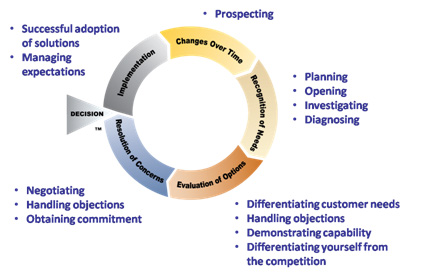
A Winning Sales Strategy - Use the Buying CycleTM

Huthwaite’s sales process is built around the customer’s buying process. Too often selling strategy gets weighed down by convoluted procedures and techniques. We’ve seen many account strategies collapse because they became so complex that the seller forgot the basic fact that decisions are made by people. All people—whether influencers, decision-makers, purchasing agents or evaluation committees—progress through discrete phases when they make decisions. By understanding these stages and how to influence them, salespeople find it easier to form practical account strategies that move sales forward.

Buying Cycle

Effective selling begins with an understanding of how people buy. Winning Sales Strategies has at its core the buyer’s perspective—embodied in the Buying Cycle™ as seen above, mapped to the stages of the typical sales process.

Changes over Time: During this period, prospects have not yet recognized a need for change. Sellers (and their marketing departments) can help jump start the buying process by delivering provocative and compelling prospecting messages that help buyers appreciate potential challenges and opportunities.

Recognition of Needs: During this stage, potential buyers become dissatisfied with their existing situation and begin to realize a need to solve a problem or exploit an opportunity. The role of the seller is to uncover the source of dissatisfaction and increase the buyers’ perception of its intensity and urgency.

Evaluation of Options: Once they’ve agreed on the need for change, buyers then start considering alternatives for resolving their dissatisfaction. Here, the sales professional’s job is to help buyers understand how the selling organization can best address their needs. The excellent seller will influence the criteria the customer organization uses to evaluate competing vendors in his or her favor.

Resolution of Concerns: Next, buyers tentatively select a vendor, but before signing the contract they will assess any associated risks and consequences. Sellers need to uncover these concerns or fears and help resolve them.

Decision: At this point, the deal is agreed upon and the contract is signed.

Implementation: After the sale, the organization begins to introduce, test and install the seller’s solution. Buyers expect to receive the value promised by the seller and to realize a return on their investment. The seller’s responsibility is to help the customer adopt the solution, manage expectations, and overcome any implementation challenges.

Changes over Time: The cycle does not end just because the customer is implementing a solution. Inevitably, there will be changes in the account—contacts may turn over, company strategy may change, reorganizations or mergers may occur. Each of these changes offers opportunities for the seller to strengthen the relationship by helping buyers anticipate and address additional problems and opportunities.

By looking at the sales cycle through the lens of the customer, salespeople not only develop strong, on target strategies, but will also by definition remain customer-focused throughout the process. And as we all know, customer focus is the heart of both great sales and great service—which have come to be expected in the current buyer’s market.


Having your FREE evaluation with a business coach is a $500 value. 

Spin Selling: Pipeline Predictability


By Huthwaite (Creator of Spin Selling):

Author William Gibson has famously said that the future is already here; it’s just unevenly distributed. In sales, you can sense the future in action wherever early adopters in positions of leadership have moved beyond their competitors by taking advantage of the best new ideas and technologies.

Today the future seems to be arriving faster than it used to: The recession of ‘08-‘09 has accelerated trends that were inevitably going to reshape the sales function in any case. Business analytics and uncertain markets have combined to fuel a drive toward operational efficiency on a scale that has no precedent.

Most sales VPs can list a dozen ways in which their organizations are doing a better job now than they were in past years: smarter hiring, more customer-focused processes and policies, new technology platforms, stronger sales-and-marketing alignment, and so on. But if they’re speaking frankly, they’ll also acknowledge one area where they’re not making progress: forecasting.

They have installed CRMs, established sales processes, and invested in sales training, but still cannot consistently deliver forecasts that senior management can feel confident about.

Forecast accuracy depends on pipeline predictability, and pipeline predictability is an elusive goal. How does revenue go astray in the pipeline? Let’s count the ways:

1. Deal slippage―the opportunity moves back to an earlier stage in the pipeline.
2. Stalled deal―the opportunity doesn’t move back, but it doesn’t move forward either.
3. Wrong stage―the sales rep has misread the buying signals.
4. Incorrect revenue amounts―the rep thinks the deal is worth more than it really is.
5. Unrealistic timelines―progress is being made, but more slowly than anyone on the sales side expected.

All these problems stem from a single source: the subjective view of the sales rep. In any of the software-as-a-service CRMs, it’s the sales rep who makes the decisions about the data to enter―pipeline stage, revenue amount, etc.

Even the best salespeople―sometimes especially the best salespeople―want to believe that the deal is bigger, more solid and closing sooner than the facts might suggest. But what exactly are the facts? Where exactly are the facts?

It is not uncommon for multiple layers of management to be involved in checking and qualifying the numbers, which means that operational efficiency is being eroded by both the fuzzy forecast and the wasted time of senior people.

Scrutiny of the pipeline is at an all-time high, but the reliability of the numbers has not improved. Forecast inaccuracy remains an enduring problem. But that’s what the present looks like. What about the future?

The future offers forecasting tools powered by objective data. It promises a CRM 2.0 system that salespeople will want to use, because it helps them close deals. It provides sales management with reliable, transparent and easily available numbers. It holds the potential for 89 percent better quota achievement.*

In the future, sales training, sales methodology, account strategy and pipeline management will all function as parts of a whole, creating sales forces of unprecedented agility and effectiveness.


Having your FREE evaluation with a business coach is a $500 value. 

Spin Selling: Pitch Early, Lose Often!


By Huthwaite (Creator of Spin Selling):

We all know that selling features too early is an ineffective and counter-productive selling technique. But if you’re being totally honest with yourself have you allowed some bad habits to creep back in, particularly during the boom years? Could it be that these bad habits are now preventing you from winning business in this tougher and more demanding market? The truth is we all were spoiled by the good times and probably all became a little lazy in our approach. Not convinced? Ask yourself the following questions:
  • Did you pitch too early in the last sales call you made?
  • Did you pass along a brochure at the outset of the meeting?
  • Did you tout the impressive bells and whistles of your product or service as opposed to focusing the conversation on the problems that your product or service solves?
  • Did you end up going down any rabbit holes because you didn’t prep the call properly?
  • Did you default to your well-worn talk track and lose the audience?
We’re willing to wager that there are a lot of people who have fallen back into these traps even when they know better! If you have the slightest inclination that you may be one of those people then the solution is very simple – go back and revisit the fundamentals of selling. Yes, it’s all about back to basics! There is no great secret or new technique and as Neil Rackham likes to say, “Good selling is good selling regardless of the market conditions.”

So dust off your copy of SPIN Selling and refresh your memory. The beauty of Neil Rackham’s research is that it is perennially true because it is based on behavioral psychology. It is based on human nature. The principles don’t change with the dynamic—or entropic—marketplace and economy.

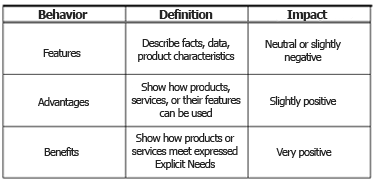
Let’s revisit a bit of the research on Features:

Overall, the levels of Features presented are slightly higher in unsuccessful calls. But the difference is small enough for us to conclude that the conventional wisdom is right—Features are neutral. They don’t help the call, but they don’t harm it much either. In larger sales, Features have a negative effect when used early in the call and a neutral effect when used later. Users respond more positively to Features than do decision makers. Features are low power statements that do little to help you sell. It’s better to use Benefits than Features.

A Benefit shows how a product or service meets an Explicit Need expressed by the customer.


      chart375

Now go back to the list of questions at the beginning of this piece and on your next sales call, check yourself if you start to fall into one of those traps.

When you get in front of a client resist the temptation to wow them with those cool features you’ve been told will sell the product for you. Focus on digging into the client’s business drivers and map the benefits of your solution to those explicit business drivers. Be disciplined in your approach and above all else, be patient – it’s often one of the key differentiators between average and excellent sales people.

Remember whenever you feel yourself about to pitch ask yourself, “Is what I am about to say driven by my own impatience or the client’s explicit need?” If it is the former, stop yourself and instead ask some better questions.


Saturday, October 30, 2010

Spin Selling: The Value Drivers of 21st Century Selling


By Huthwaite (Creators of Spin Selling):

You may be at least passingly familiar with what Huthwaite calls the Client Insight Creators—that is, the drivers of value in 21st century selling. “Value” is a difficult word to pin down. It tends to be rather vague in current usage, because everyone seems to mean something a little different. In the sense we are using it, there are at least four competing definitions from the Random House Dictionary:

value

monetary or material worth, as in commerce or trade: This piece of land has greatly increased in value. the worth of something in terms of the amount of other things for which it can be exchanged or in terms of some medium of exchange. equivalent worth or return in money, material, services, etc.: to give value for value received. estimated or assigned worth; valuation: a painting with a current value of $500,000 —and that’s just the noun!

What precisely does it mean, for example, when a customer reports having received “value” in the course of the sales process itself? We’ve actually developed some insight from our research that will offer some precision to the term. We assembled data on several thousand transactions which met two rather curious criteria:

The customer reported that in an effort to purchase a particular product, service or bundle of capabilities, they were faced with a group of competitors seeking their business whose offerings all looked the same. In other words, despite the best intentions of the sellers to differentiate themselves, the buyer could find only one clear differentiator: Price. Despite the almost absolute similarity of the products or services, the customer in these transactions did not select the lowest-price offering.

We reckoned it somewhat bizarre behavior—but realized that if we could understand why, we might gain some understanding as to what customers mean by “value.” At its simplest, these customers reported that they were willing to forego price concerns when in the buying process they experienced one or more of the four scenarios, which we call value drivers. That is, these customers were willing to pay a premium, redefine the buyer/seller relationship, erect barriers to the seller's competitors and establish the seller as a trusted adviser when:

The seller discovered a problem the customer was unwittingly experiencing
The seller identified a superior solution to a problem the customer was experiencing
The seller explored a previously unseen opportunity with the customer, and/or
The seller brokered all of his company’s capabilities on the customer’s behalf, or effectively cross-sold.

Each of these scenarios (the Unrecognized Problem, the Unanticipated Solution, the Unseen Opportunity, and the Broker of Capabilities, or Cross-selling), provides a depth of insight to the customer that they did not previously have. We therefore call them the collectively the Client Insight Creators. Each relies heavily on expertise of the salesperson as seller; the expertise that is gained in the field by interacting with a wide swath of customers across industries.


Having your FREE evaluation with a business coach is a $500 value. 
Spin Selling: Why Questions Matter


By Huthwaite (Creators of Spin Selling):

Questions matter. There is no doubt about it. The SPIN® Model implies that questioning skills are the most important skills that a seller can develop. But why? There are three main reasons that questions matter so much in the selling environment:
  • Questions allow the seller to control the flow of the conversation
  • Questions produce answers that the seller needs in order to understand and develop needs
  • Questions play into the Confirmation Bias
The first two are more or less self explanatory. The third may require a little explanation. There is a cognitive bias in behavioral psychology known as the Confirmation Bias. From it we derive what we call the “Boundary Conditions of Communication.”

People value what they say and their own conclusions more than what they are told People value what they ask for more than what is freely offered In other words, a customer will always value the conclusions he himself draws—with the assistance of guiding questions—more than those that are shoved down his throat. To tell a customer what he needs, and how you as a seller can help meet those needs, is to fail in the modern selling environment. A customer will always prefer to work out for himself what he needs, and what he requires from you to meet those needs. But he may require your humble assistance—asking the right questions—to help him see clearly for himself. So ask questions that are helpful and insightful. The customer is not looking to fill in the gaps in your knowledge. Rather, he wants help structuring his thinking; he wants your questions to lead him down the path of self-discovery.

Early in the relationship, the questions you ask are vitally important. They provide the framework for pattern recognition by the buyer. You must do most of the questioning and you’ll occasionally create value (using the client insight creators) with insights that keep the buyer engaged and grateful. You will have to ask some necessary questions to fully understand the customer’s situation, but realize that those questions may not inspire him!

Once the customer has had an “aha” moment (in which he recognizes something of value to him) and has stated a specific want or desire, he’ll begin to do most of the questioning. He will now be seeking advice and expertise, and you will able to create more and higher value in the context of the second Boundary Condition (People value what they ask for more than what is freely offered). It has been said that one knows one is genuinely a consultative seller when the customer begins responding to questions with a thoughtful pause and then a question of his own.


Having your FREE evaluation with a business coach is a $500 value. 

Friday, October 29, 2010

Miller Heiman: Harness the Power of Client Relationships (Part 4)


The conventional wisdom:

“Build it and they will come. In other words, the right product will sell itself.”

The reality:

“Even the best product in the world will fail if customers don’t understand and appreciate the value it can provide.”

If you’re a baseball fan, “Field of Dreams” is probably one of your favorite movies. Starring Kevin Costner, it’s a moving story about the beauty of redemption - how some people, most notably the disgraced ballplayer, Shoeless Joe Jackson, can be given a second chance in life. But the movie’s iconic line – “If you build it, he will come” (“it” being a baseball field and “he” being Jackson) – has become the mantra of many salespeople who mistakenly believe that all they need to be successful is for their company to build the right products. If only business were that simple! Even the best offerings never sell themselves. In fact, the failure rate for new products is notoriously high, often topping 50 percent.

To be fair, business gurus have been touting such approaches for years with catchy phrases like “mass customization” and “markets of one,” but the concept has been slow to catch on. Not every implementation has led to success. Levi Strauss learned a painful lesson: most people aren't willing to endure the hassle of being fitted for a custom pair of jeans (and paying a premium for it) when off-the rack clothes are “good enough.” But companies now have greater experience in mass-customization approaches and the required technology has become substantially cheaper. As a result, consumers can now customize their own sneakers, clothes, jewelry, stamps, and even M& Ms. Mass Customization has evolved such that some services are automatically customizing themselves to their users.

Pandora.com provides custom radio stations for more than 20 million listeners based on their subscriber preferences. What Job Is Your Product Doing? The late Peter Drucker once wrote, “The customer rarely buys what the business thinks it sells him.” You might think Drucker was being facetious. But in my decades of experience in the selling profession, I would have to say his remark is much closer to the truth.  “You don’t really know what you’re selling until you know what the customer is buying.” One effective approach to uncover what customers truly need is to think of your product as an offering that must be “hired” in the marketplace.

Customers don’t buy a product because of its features. They buy it because they intend it to perform a certain job. A salesperson, for instance, might not buy a new car to get from point A to point B; rather, she “hires” the car as a mobile office. For her, certain features (i.e. hands-free phone operation) would be more important to her than to other buyers. As such, markets shouldn’t be segmented by customer demographics. Instead, markets should be segmented by the solution each product provides. That analysis will reveal the features valued by certain customers, contends Clay Christensen, author of the bestseller “The Innovator’s Dilemma.” To explain how that works, Christensen and his colleagues cite the example of a milkshake.

When a fast-food restaurant discovered that 40 percent of milkshakes were being bought in the early morning, company executives asked the question, “What’s the job that early-morning customers are hiring a milkshake to do?” As it turned out, most of those customers were “hiring” a milkshake not necessarily as a source of nourishment but as a means to ease the boredom of a long commute. Consequently, the fast-food company realized that the way to improve its milkshake was to make the product more interesting (by adding fruit) and to make it last longer (by thickening it). While adding fruit made the product healthier, it wasn’t the point. Those early-morning customers primarily wanted something that would help pass time.

Christensen and his colleagues contend that every product’s job is to solve a problem. The job of Louis Vuitton luggage, for instance, goes well beyond just the utilitarian. Such high priced items need also to convey a sense of luxury and exclusivity. Otherwise, they simply haven’t done their job.

In a business-to-business transaction, customers hire a product with the ultimate goal of making more money. The question is how will your product help the customer accomplish that goal? To answer that question, you need to have a complete understanding of your customer’s business. Years ago, Hill-Rom Co., a manufacturer of medical equipment, shrewdly realized that the job of its hospital beds was not merely to provide a place for patients to rest and recuperate. The company recognized that nurses constitute a large chunk of a hospital’s operating budget and that hospital beds could be hired to keep those costs in check. To prevent injuries to nurses, for example, Hill-Rom added various features to make it easier for them to get patients into and out of beds. That kind of extra functionality can help save hospitals money over the long run, and is the reason why Hill-Rom Co. has been able to charge premium prices for its products.

Getting Customer Commitment: As discussed earlier, it’s notoriously difficult for companies to discern exactly what their customers truly value. Inaccurate information can lead to the creation of products nobody wants. To avoid such disasters, some companiesbuild business models that rely on obtaining customer commitment early in the product-development phase. In the real-estate market, for example, consumers will often place a substantial down payment on a condo or house in a project during (or even before) the construction phase.

For the developer (or seller), the advantages are clear –obtaining such commitments from buyers early on greatly decreases the chances that the company will end up building something nobody wants. In other words, when you build it, they will come because they’re committed to come. And that commitment can be more than just financial. With real-estate developments, a consumer might be involved in the design process, choosing the layout of rooms, types of appliances, and so on.

Would You Like To Have A FREE BUSINESS COACHING SESSION?
Having your FREE evaluation with a business coach is a value of $500.
Just Fill Out The Form Below:

Miller Heiman: Harness the Power of Client Relationships (Part 5)

The conventional wisdom:

“Build it and they will come. In other words, the right product will sell itself.”

The reality:

“Even the best product in the world will fail if customers don’t understand and appreciate the value it can provide.”

If you’re a baseball fan, “Field of Dreams” is probably one of your favorite movies. Starring Kevin Costner, it’s a moving story about the beauty of redemption - how some people, most notably the disgraced ballplayer, Shoeless Joe Jackson, can be given a second chance in life. But the movie’s iconic line – “If you build it, he will come” (“it” being a baseball field and “he” being Jackson) – has become the mantra of many salespeople who mistakenly believe that all they need to be successful is for their company to build the right products. If only business were that simple! Even the best offerings never sell themselves. In fact, the failure rate for new products is notoriously high, often topping 50 percent.

Lessons for Managers Understanding what customers value is far easier said than done. But without a good grasp on what customers truly want, new products can flop in the marketplace. Miller Heiman believes sales organizations must incorporate a process that allows reps to figure out what the customer is trying to fix, do better, or avoid.

1. Listen to Those on the Front-Line. To gain a deeper understanding of what customers want, managers should regularly tap into the collective knowledge of their front-line sales force. Omron, a Japanese manufacturer of control equipment, factory automation systems, and other electronics learned that an Asian manufacturer of printed circuit boards (PCBs) was having trouble determining whether solder paste was too old to be used. Traditionally, that assessment made based on workers’ discretion, resulting in costly false negatives. Omron began developing an automatic sensor for determining the age of solder paste. According to Omron founder Kazuma Tateisi, “Selling products is not enough. I want representatives to bring back needs from the customers – as many as possible, as quickly as possible. That is the other half of a salesperson’s job.”

2. Walk In Your Customers Shoes. Market research and customer surveys reveal only so much. To truly understand your market, you need to walk in your customer’s shoes, literally. Workers from one Weyerhaeuser’s sawmills in Cottage Grove, Oregon, took turns spending a week working at their customers’ sites (i.e. customer-service reps became sales associates at Home Depot stores). The insights gained were invaluable in improving Weyerhaeuser’s products and services. Based on such information the company wrapped lumber in plastic and stacked it onto railway cars in a way that was easier for customers to unload, increasing the operating efficiency of those businesses. Moreover, the service reps gained a deeper understanding of customers and could handle problems more effectively. Weyerhaeuser became a valued partner in its customers’ operations.4. Help Your Customers Succeed – Even When Your Products Aren’t Directly Involved. Every customer values success –something sales organizations can capitalize on by going out of their way to increase their customers’ competitiveness.

General Electric (GE) has various initiatives in place to help its customers improve their businesses. It shares its expertise in Six Sigma and other management methodologies free of charge, often by conducting workshops at the customer site. GE even provides services in areas outside of those that directly involve its products. The aircraft engines division helps airlines become more profitable by providing management expertise in flight scheduling and finance. The company doesn't do this out of some altruistic or magnanimous sense of noblesse oblige. Rather, it’s done out of pure self-interest: the healthier the airlines are, the more they’ll buy aircrafts with GE engines. GE rightly realizes that,over the long run, it can win only if its customers win. 

3. Look Beyond the Obvious. Far too many companies fall back on the obvious instead of doing the hard work of figuring out the real customer value of that offering. One chain of scuba diving shops wanted to advertise diving classes. The obvious course of action would have been to target subscribers of scuba-diving magazines who lived in areas near the stores. But the retail chain did its homework and found that many people who took the classes were engaged couples preparing for honeymoons in the Caribbean, Hawaii, or other tropical locations. For them, the true value of the classes wasn’t simply learning how to dive. What they really wanted was to enjoy their honeymoons doing something fun together. That insight suggested that a better use of the company’s marketing budget might be ads in Brides magazine rather than Dive magazine.

4. Free Customers from Work They Dislike. Sometimes, providing customer value means taking over a job they’d prefer not doing themselves. That’s what happened with Nalco Chemical, which manufactures industrial chemicals for clients such as steel mills and paper plants. Years ago, Nalco realized its customers disliked dealing with water-treatment problems. They wanted to focus on their core businesses: steel manufacturing, paper production or oil refining. Consequently, Nalco decided to take over that onerous but all-important part of their customers’ operations, and today the company has built a substantial business in providing water-treatment services. It is important to note that Nalco learned of that business opportunity because its sales reps and managers were regularly spending considerable time in the field talking with customers.

Unfortunately, far too many companies still don’t understand what selling is all about, and require salespeople to push volume instead of value. In doing so, they are frequently forced to slash prices to keep products moving. Such discounts are a copout. When salespeople can’t prove value, they resort to price cuts. In my book, product discounts are nothing more than a euphemism for bribes, and pushing volume by lowering prices ultimately means a race to become the cheapest supplier of a commodity. Few companies can survive that precarious existence. Research by McKinsey & Co. found that, to offset a price cut of just 5 percent, the typical S&P 1500 company would need to increase sales by 19 percent. Few businesses can pull that off.18 Instead, the smarter strategy is to sell value, not volume, by proving to customers how your products will improve their businesses.

The real motto sales organizations should follow is this: “If you prove value, they will come.”

Would You Like To Have A FREE BUSINESS COACHING SESSION?
Having your FREE evaluation with a business coach is a value of $500.
Just Fill Out The Form Below:

Miller Heiman: Harness the Power of Client Relationships (Part 3)

The conventional wisdom:

“Build it and they will come. In other words, the right product will sell itself.”

The reality:

“Even the best product in the world will fail if customers don’t understand and appreciate the value it can provide.”

If you’re a baseball fan, “Field of Dreams” is probably one of your favorite movies. Starring Kevin Costner, it’s a moving story about the beauty of redemption - how some people, most notably the disgraced ballplayer, Shoeless Joe Jackson, can be given a second chance in life. But the movie’s iconic line – “If you build it, he will come” (“it” being a baseball field and “he” being Jackson) – has become the mantra of many salespeople who mistakenly believe that all they need to be successful is for their company to build the right products. If only business were that simple! Even the best offerings never sell themselves. In fact, the failure rate for new products is notoriously high, often topping 50 percent.

Preventing Customer Failure: 

Nearly every manager understands that people who are unhappy with your product or service aren’t likely to make repeat orders. And, worse, disgruntled customers will spread word of your shortcomings, hurting your reputation in the marketplace. The problem is that many managers don’t empower those on the front-lines to deal with customer complaints. Years ago, Southwestern Bell Yellow Pages did not have adequate processes in place to handle customer problems such as mistakes in listings. That deficiency was hurting the bottom line because businesses that couldn't resolve;their problems in a satisfactory way were twice as likely to cancel their ads the following year. So Southwestern Bell granted its service reps the authority to adjust customer bills by up to $1,000 to help resolve problems. At first, managers were leery of the new policy, fearing that the reps would make indiscriminate reimbursements. But just the opposite happened. Both the number and size of those adjustments decreased. Customers are now less likely to become disgruntled because their problems could be resolved on the spot.

Some forward-thinking companies are going one step further. Not only are they paying the necessary attention to handle customer issues quickly, they are doing what they can to prevent those problems from occurring in the first place. They make the extra effort to ensure their customers extract the expected value from their products. Consider the pharmaceutical industry. Companies like Pfizer and Merck have developed wondrous drugs, but many patients fail to take their prescribed medications when they should. In the United States, for example, almost half of people who are prescribed drugs for lowering their blood pressure don’t follow through in taking those pills. While it’s primarily the customer’s fault for forgetting or failing to take the prescribed medication on time, what if drug companies found ways to make it easier for customers to take their medicine? Take, for instance, how some birth-control pills are now being packaged. The difficulty with taking oral contraceptives is that the protocol can be difficult to remember. It’s easy for someone to confuse when to take the pill. So some manufacturers of oral contraceptives came up with an ingenious solution: they packaged the pills sequentially and added placebos, which greatly simplified the protocol as users only had to remember to take one pill every day.

That proactive approach makes tremendous business success. When your customers fail to correctly use your products, your company has ultimately failed too. Unfortunately, far too many businesses don’t go the extra step in helping customers avoid failure. Their feeling is that, when customers make a mistake, tough for them. Customizing Products and Services The second factor that can differentiate between customers who are merely satisfied versus those who are totally satisfied is providing a product or service that is (from the customers’ perspective) tailored to them. In some industries, that’s the standard operating procedure.

Many equipment manufacturers, for instance, regularly custom design one-off pieces of machinery for specialized applications, and consulting firms routinely tailor their services to the unique needs of their clients. In other markets, the norm is to provide customization while taking advantage of the economies of scale of mass manufacturing. Perhaps the most famous model for that approach is Dell Inc. Consumers can order a computer online to fit their exact needs: the right amount of memory, speed of microprocessor, size and type of monitor, etc. Dell then quickly assembles the machines and ships them to customers. Thanks to this lean, efficient approach to product customization, Dell has built a multibillion-dollar business, forever changing the PC industry.

Would You Like To Have A FREE BUSINESS COACHING SESSION?
Having your FREE evaluation with a business coach is a value of $500.
Just Fill Out The Form Below: